

Utility Billing for Student Housing: What's Different and Why It Breaks Down
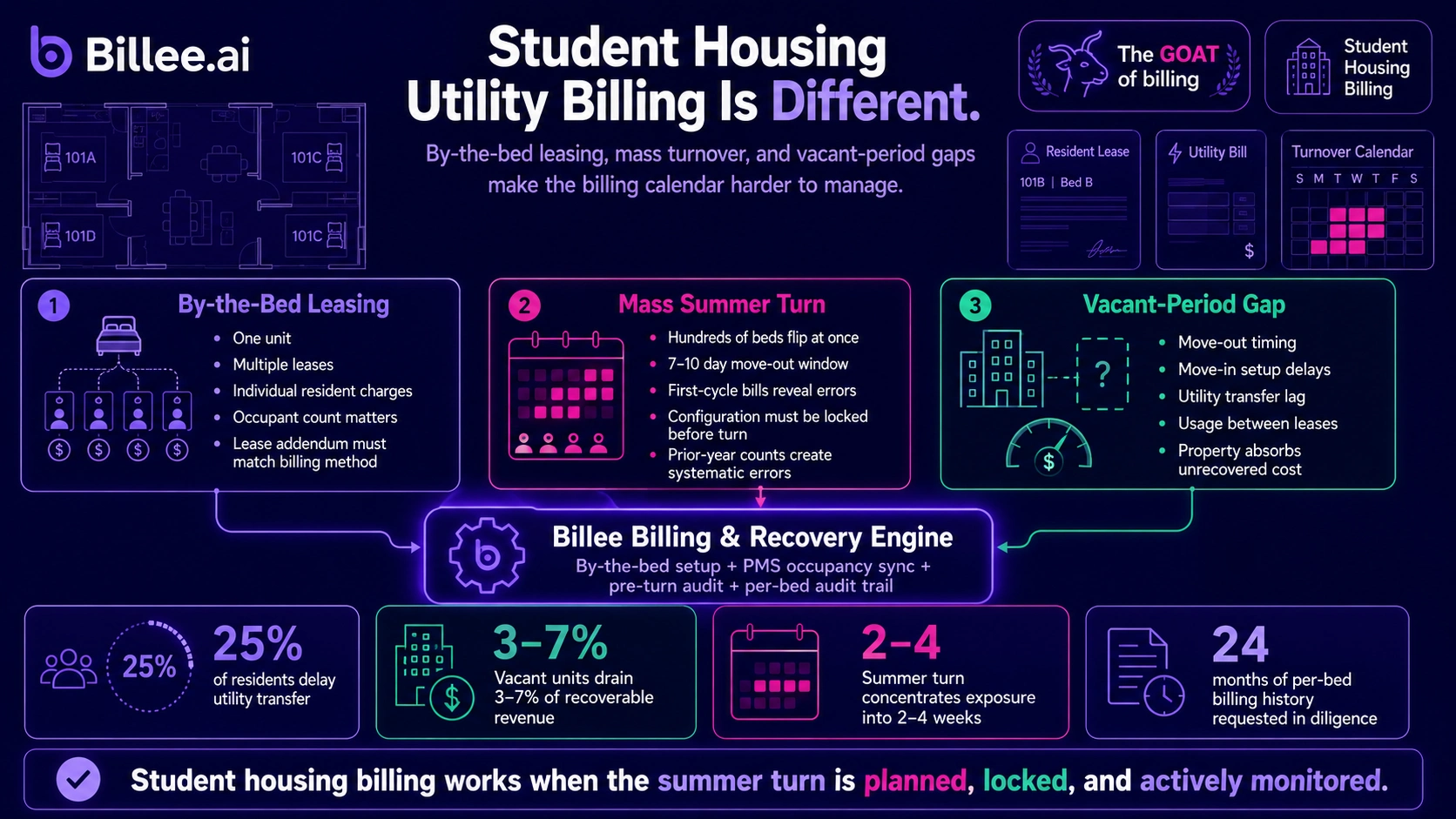
Student housing utility billing is more operationally intensive than conventional multifamily because of by-the-bed leasing, mass annual turnover, and the billing gap that opens when hundreds of beds flip simultaneously. RUBS and submetering are both viable methods, but neither works reliably without a locked billing process for the summer turn, active vacant cost recovery for move-in and move-out gaps, and lease addenda that accurately describe the allocation method in use. Billee's Billing and Recovery Engine is configured for the by-the-bed structure and manages the full billing cycle for student housing portfolios, including the summer turn and the vacant-period gap.
Key Takeaways
By-the-bed leasing is the core complication. Billing a unit shared by multiple residents requires allocation rules the lease addendum must describe precisely, and a mismatch between the addendum and the billing method is the most common audit finding in student housing.
The annual summer turn is the highest-risk billing period. Every unit flips simultaneously, and a billing gap that goes undetected across hundreds of beds can absorb tens of thousands of dollars in a single cycle.
About 25% of residents delay transferring utilities into their name after move-in, creating vacant-period cost exposure that requires active management rather than reactive billing.
RUBS remains legal for existing student housing properties in most states. Colorado's HB26-1013 (signed March 2026) allows RUBS to continue for existing properties but requires direct metering or submetering for new builds permitted after July 1, 2027.
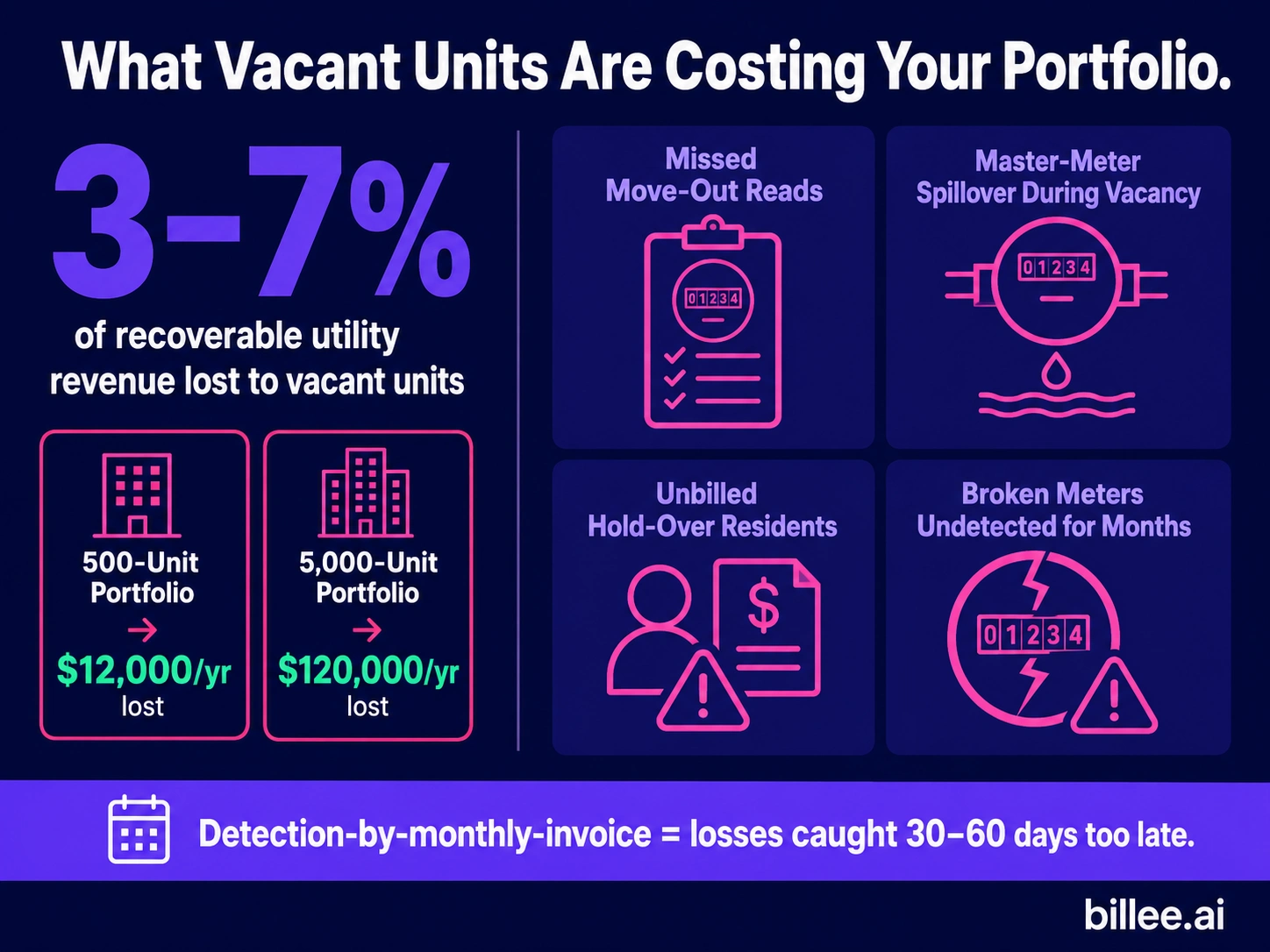
Vacant units quietly drain 3–7% of recoverable utility revenue from a typical portfolio. In student housing, where the entire portfolio turns at once, the exposure concentrates in a narrow 2–4 week window each summer.
Institutional buyers treat student housing as an active acquisition target. Twenty-four months of per-bed billing history is a routine due diligence request, and gaps in that record affect valuations.
At a Glance: RUBS vs. Submetering in Student Housing
| RUBS | Submetering | |
|---|---|---|
| Setup cost | Low | Higher (retrofit or build-in) |
| Billing accuracy | Formula-based; reflects allocation, not per-bed consumption | Per-unit meter reads |
| Best fit for student housing | Existing buildings without individual meter access | New builds; properties in states requiring direct metering |
| Summer turn risk | High if occupant counts are not updated before new cycle | Lower; meter reads document actual usage per period |
| State compliance (2026) | Legal in most states; check local allocation caps | Required for CO new builds permitted after July 1, 2027 |
| Resident acceptance | Mixed; depends on disclosure clarity and billing consistency | Higher; residents see their own consumption |
Why Student Housing Utility Billing Is Different from Conventional Multifamily
Student housing introduces three structural differences that do not appear in conventional multifamily billing.
By-the-bed leasing. In a conventional apartment, one lease covers one unit. In student housing, each bed in a shared unit typically has its own lease. The billing system must translate a single utility invoice for the unit into individual charges per resident. The allocation formula, the occupant count, and the lease addendum language must all describe the same method. When any of these three elements fall out of sync, the billing is legally difficult to defend.
Mass simultaneous turnover. A conventional 300-unit community turns over roughly 20–30 units per month on a rolling basis. A 300-bed student housing property typically turns every bed in the same 7–10 day window at the end of the academic year. Billing systems configured for rolling turnover produce systematic errors when the entire portfolio moves simultaneously. The billing process must be designed and locked before the turn begins, not rebuilt during it.
Guarantors. Many student housing leases involve a parent or co-signer as guarantor. Billing disputes that escalate to a guarantor add a resolution layer that does not exist in conventional multifamily, and the billing record must be detailed enough to support that process without reconstruction.
RUBS vs. Submetering: What Actually Works
Both methods are viable in student housing. The choice depends on building infrastructure, state rules, and portfolio scale, not on which method is "better" in the abstract.
RUBS in student housing works when the occupant count used in the allocation formula reflects the actual resident population in each billing period. This is where most student housing RUBS failures originate: the formula is correct, but it runs on stale occupant data. After a mass turn, if the new resident count has not been updated before the first billing cycle, every resident in the property receives a charge calculated on the wrong denominator. Updating occupant counts before the first post-turn billing cycle is not optional; it is the single most operationally critical step in the student housing billing calendar.
Submetering in student housing provides per-unit consumption data that eliminates the allocation dispute and produces a billing record residents can verify against their own usage. The tradeoff is upfront infrastructure cost, which is more manageable in new construction than in retrofits of older buildings. Colorado's HB26-1013 (signed March 2026) requires new residential buildings permitted after July 1, 2027 to use direct metering or submetering rather than RUBS, while allowing existing properties to continue with RUBS. Operators building new student housing in Colorado need to factor this into their billing infrastructure planning before permits are filed.
The method itself is secondary to whether the billing system is correctly configured for the by-the-bed structure and whether the lease addendum matches the method in use. A correctly configured RUBS system outperforms a poorly documented submetering system in any billing audit.
The Summer Turn: The Highest-Risk Billing Period of the Year
The summer turn concentrates more billing risk into a shorter window than any other period in the multifamily calendar. Every bed moves out and moves in during the same week, utility service continuity must be maintained, and the billing system must process the entire portfolio's account changes without a gap.
Operators who manage large student housing portfolios consistently report the same pattern: the first bills produced after the summer turn are the clearest early signal of whether a billing system is running correctly. Anomalies in those first-cycle bills, such as charges that don't match expected per-bed amounts or units billed at last year's occupant counts, are the earliest detection point for a systematic configuration error.
Three billing failures are most common during the student housing turn. The first is occupant count lag: the billing system runs the first post-turn cycle on the prior year's resident count because the update was not made before billing locked. The second is move-out charge misallocation: charges for utility usage during a resident's final days get applied to the incoming resident's first bill rather than the outgoing resident's account. The third is vacant-period gap: utility service runs continuously through the turn, but the billing record shows a gap between the outgoing lease end date and the incoming lease start date. That gap accrues to the property rather than to either resident.
Preventing these failures requires a pre-turn billing audit before move-out begins: verifying occupant counts, confirming vendor account credentials are current, and locking the billing configuration so no changes can be made during the turn window itself.
Vacant Cost Recovery in Student Housing
Vacant cost recovery is the process of identifying and billing utility costs that accrue during periods when a unit or bed should have been in a resident's name but was not, due to move-in or move-out timing errors, delayed utility transfers, or occupancy gaps in the PMS.
In conventional multifamily, vacant cost recovery operates continuously but at a moderate pace. In student housing, the exposure concentrates in the 2–4 weeks surrounding the summer turn, when move-out charges, move-in setup delays, and the 25% of residents who delay utility transfer all overlap in the same billing window. That concentration makes VCR both more impactful and more time-sensitive in student housing than in a conventional portfolio.
Billee's Vacant Cost Recovery engine monitors occupancy data from the PMS against actual meter usage on a continuous basis. When a bed flagged as vacant shows usage above threshold, an exception is generated and routed to a named Billee account team member who takes action, not just a dashboard alert that waits for the property manager to notice. Vacant units quietly drain 3–7% of recoverable utility revenue from a typical portfolio. In student housing, where the turn compresses the entire year's exposure into a few weeks, an active recovery program rather than a reactive one is the difference between recovering most of that revenue and recovering none of it.
State Rules That Affect Student Housing Utility Billing
State compliance for utility billing is not uniform, and student housing portfolios that operate across multiple states cannot apply a single billing configuration to every property.
Colorado. HB26-1013, signed March 26, 2026, is the most significant recent legislative change affecting student housing operators. The law allows existing properties to continue using RUBS but requires that new residential premises applying for building permits on or after July 1, 2027 use direct metering or submetering rather than RUBS. Student housing developers and operators planning new Colorado properties must build this into their utility infrastructure plans before breaking ground. Source: Holland and Knight, April 2026.
Texas. 16 TAC Chapter 24 requires operators using RUBS or submetering for allocated utility billing to register with the Texas Public Utility Commission before sending the first resident bill. Registration applies to student housing properties the same as conventional multifamily. Properties that have not registered and are billing residents for allocated utilities are in violation with each bill sent.
California. Civil Code Section 1940.9 requires specific lease disclosure language before submetering begins. Student housing near universities is not exempt. CPUC General Order 103-A adds billing practice requirements for master-metered properties that apply regardless of property type.
Cross-state portfolios require state-specific billing configuration, not a national formula applied uniformly.
How Billee Manages Utility Billing for Student Housing Portfolios
Billee's Billing and Recovery Engine is configured for the by-the-bed structure from implementation, including per-bed occupant count verification before each billing cycle, per-bed audit trail for every charge, and lease addendum alignment review as part of the initial setup.
The summer turn is a scheduled event in the Billee billing calendar, not an emergency. A pre-turn audit runs before move-out begins, verifying occupant counts, vendor credentials, and billing configuration. The VCR engine runs continuously through the turn window and flags vacant-period exposure in the same billing cycle it occurs.
State-specific billing configuration is handled at implementation for every state in the portfolio. PMS integration with Yardi, RealPage, and Entrata connects billing records to occupancy data in real time, so occupant count updates flow into the billing system without a manual step.
Implementation takes 45 days. Vendor onboarding, state-specific billing configuration, and PMS integration are handled by the Billee team.
Billee manages utility billing for student housing portfolios, including by-the-bed billing configuration, the summer turn, and vacant cost recovery. Talk to the team.
FAQ: Utility Billing for Student Housing
How does by-the-bed leasing affect utility billing in student housing?
By-the-bed leasing means each resident in a shared unit has a separate lease, so the billing system must split a single utility invoice into individual per-resident charges. The allocation formula, occupant count, and lease addendum must all describe the same method. When the addendum says one thing and the billing system runs another, the property has a factual conflict it cannot defend in a dispute or audit.
Is RUBS legal in student housing properties?
RUBS is legal in most states for existing student housing properties. Colorado's HB26-1013 (March 2026) preserves RUBS for existing properties but requires direct metering or submetering for new builds permitted after July 1, 2027. Texas requires PUC registration before billing residents under any allocated method, including RUBS. California requires specific lease disclosure before submetering begins. Operators must verify the rules for each state in their portfolio.
What is the biggest utility billing risk during the summer turn?
The most common failure is occupant count lag: the billing system runs the first post-turn cycle on the prior year's resident count because the update was not made before billing locked. This produces systematic over- or under-billing across every bed in the property for the first month of the new academic year. The fix is a pre-turn billing audit that verifies occupant counts and locks the billing configuration before move-out begins.
What is Vacant Cost Recovery and why does it matter more in student housing than conventional multifamily?
Vacant Cost Recovery identifies and bills utility costs that accrue when a unit should have been in a resident's name but was not. In conventional multifamily, this exposure spreads across the year as individual units turn. In student housing, it concentrates in the 2–4 weeks surrounding the summer turn, when move-out charges, move-in delays, and delayed utility transfers all overlap. An active VCR program that flags exceptions in the same billing cycle they occur recovers most of this revenue. A reactive program that discovers gaps after the fact recovers far less.
Does Texas require utility billing registration for student housing operators?
Yes. Under 16 TAC Chapter 24, Texas operators using RUBS or submetering for allocated utility billing must register with the Texas Public Utility Commission before sending the first resident bill. This requirement applies to student housing properties the same as any other multifamily property. Billing residents before completing registration makes each bill a potential regulatory violation under the Texas Utilities Code.
Sources
Zego, "4 Common Student Housing Utility Mistakes and How to Fix Them," accessed July 2026.
Holland and Knight, "Existing Colorado Multifamily Housing Developments Can Continue Using RUBS Under New Law," April 2026.
Entrata, "2026 Legislative Roundup: New Fee, Utility Billing, and Tenant Protection Laws Property Managers Should Know," accessed July 2026.
Insights and Industry Trends


Explore more insights